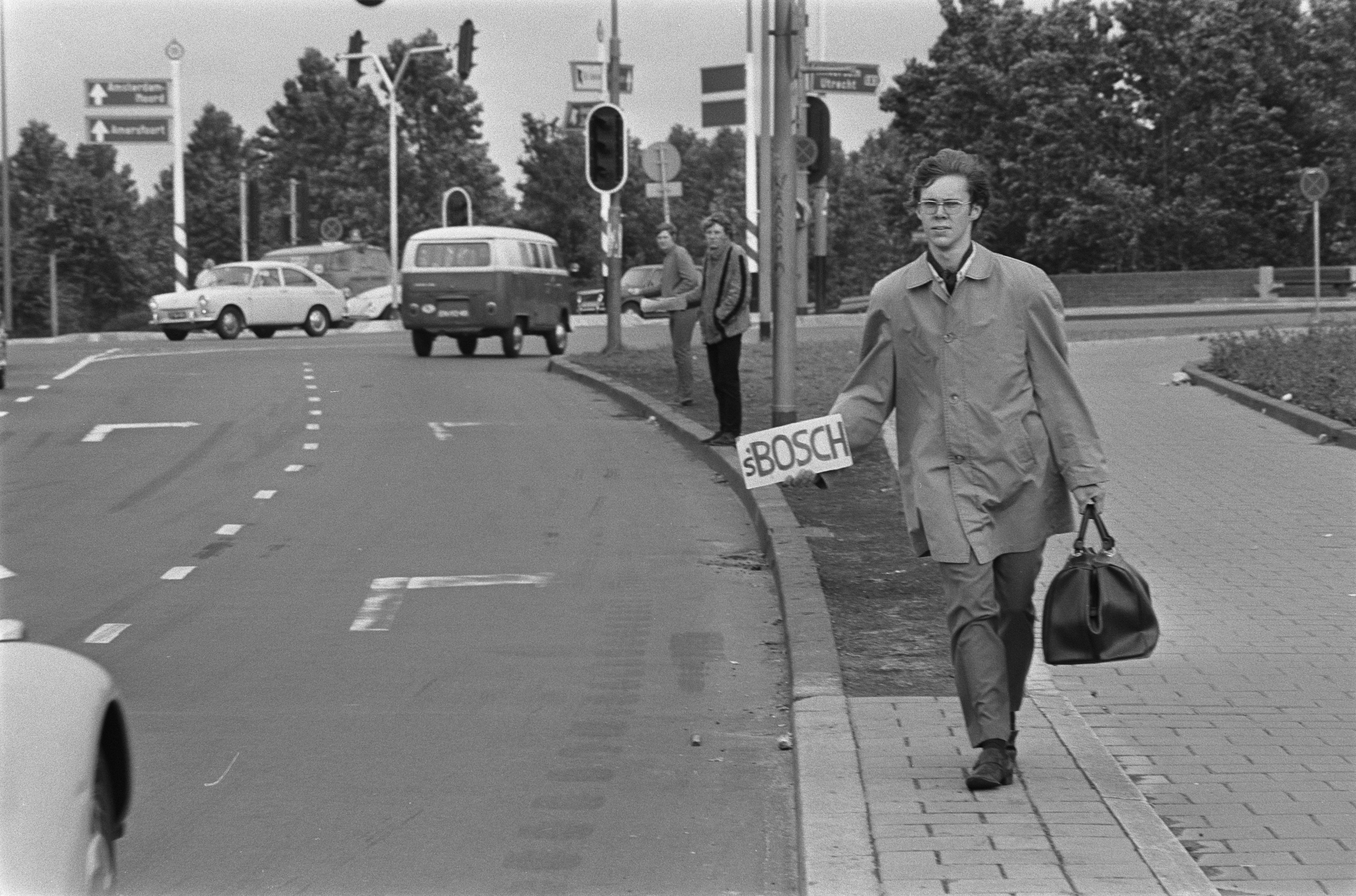

You stood with a bag at your feet and a sign in your hand. UTRECHT, it said. Or BREDA. Cars drove past. One driver glanced sideways; another shrugged. Then, a little further along, brake lights suddenly came on. Pick up the bag, walk towards the car and hope the destination was somewhere near yours.
‘Where are you heading?’
‘Utrecht.’
‘I’m only going as far as Gouda. Can you carry on from there?’
That was how a journey could begin. No ticket, no reservation and no certainty about when you would arrive.
An empty seat as transport
Especially in the 1960s, 1970s and 1980s, hitchhikers were a recognisable sight. They fitted the image of young people travelling around Europe with a backpack, but hitchhiking was practical too. Not everyone had a car, and train tickets cost money. If you wanted to visit your parents, see friends or reach a holiday destination, you could try to get a ride with someone already going that way.
Students and conscripted soldiers were among the familiar groups of hitchhikers in the Netherlands. This was transport without a timetable. You relied on an empty seat and a stranger’s willingness to offer it.
There was something simple about it: two people needed to go in the same direction. One had a car; the other did not.
Near the motorway, but not on the hard shoulder
‘Hitchhiking by the motorway’ might bring to mind someone standing beside speeding cars. But that image needs a distinction. The motorway itself is no place for pedestrians. Nor is the hard shoulder a pick-up point: drivers may stop there only in an emergency.
Hitchhiking therefore took place, among other locations, on approach roads before the start of the motorway, at designated hitchhiking stops, and at service stations and parking areas. Not every spot near a slip road was suitable or permitted. A driver needed to see you and be able to stop without endangering other traffic.
At a service station, you could also ask someone where they were heading first. That was different from holding out your thumb and trying to make contact in a few seconds.
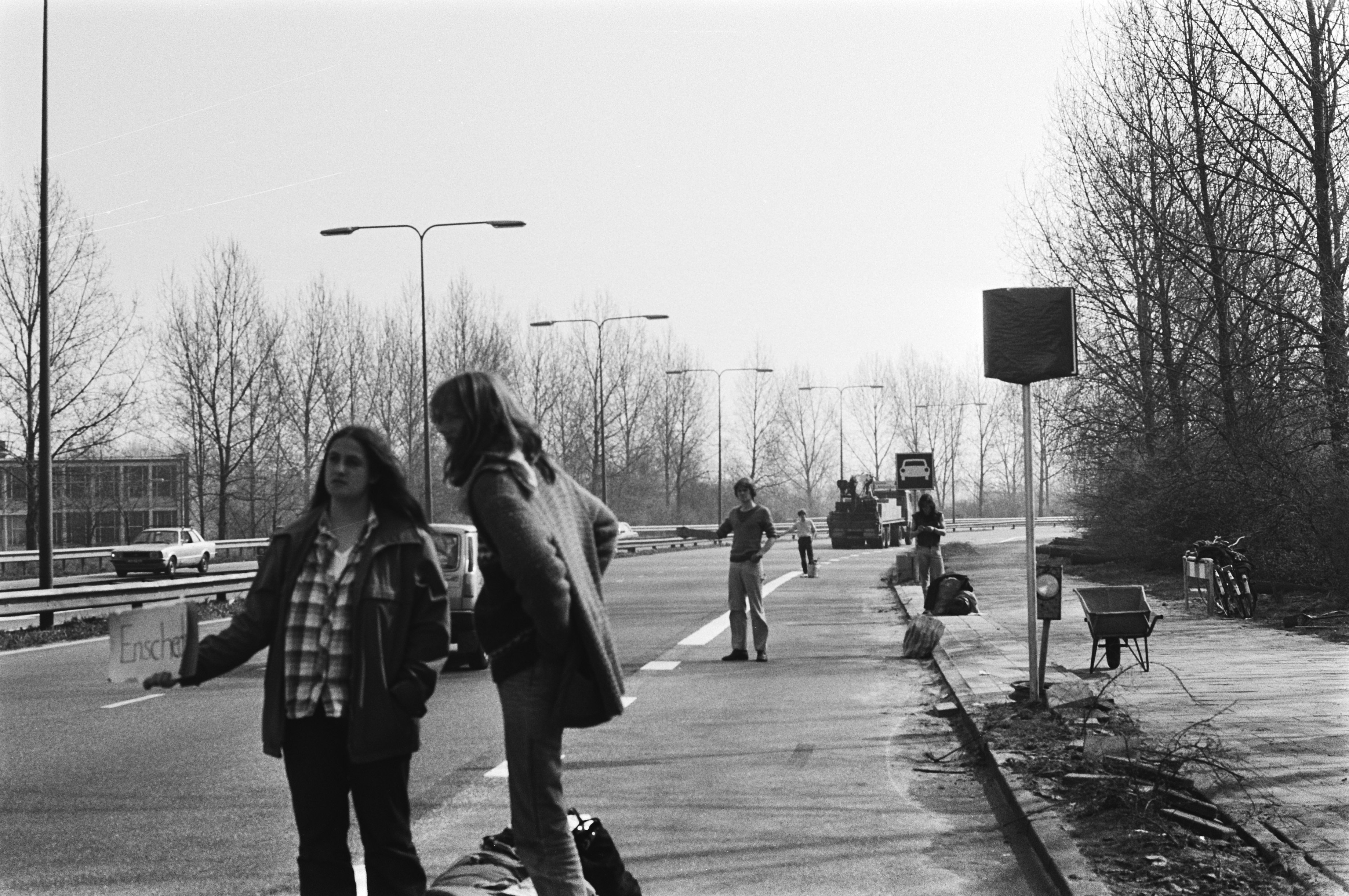
Van Smirren / Anefo · Nationaal Archief · CC0 1.0

The cardboard sign
A piece of cardboard and a thick marker were enough to announce your destination. The sign came from a box; the main thing was that the letters were readable. A distant destination might sound appealing, but a city along the way could offer a better chance of a first ride.
Hitchhiking meant weighing up your options all the time. Would you accept a ride with someone going only a short distance? Or wait for a longer journey? A lift could take you dozens of kilometres forward while leaving you somewhere almost nobody stopped.
The distance on the map did not tell the whole story. Where you got out mattered just as much.
Waiting and meeting people
Waiting was part of it. Sometimes someone stopped quickly. Sometimes you had plenty of time to doubt your sign, your spot and the entire plan. Rain softened the cardboard. Your bag seemed to get heavier even when you were not carrying it.
Once you got in, everything changed. Suddenly you were inside someone else’s little world: their music, driving style and belongings on the back seat. A conversation could start with the destination and end with work, family or a holiday years earlier.
It produced stories that a train ticket did not automatically provide. But that dependence had a downside too. You did not know in advance whose car you were getting into. Equally, the driver did not know whom they were picking up. Not every encounter was pleasant, and nostalgia does not make that uncertainty any smaller.
The train became a more attractive option
An important change in the Netherlands was the introduction of the student public transport pass in 1991. For students eligible to use it, public transport became much more attractive. Why wait by the road when you could take the train?
In 2019, Rijkswaterstaat, the Dutch national road authority, told the NOS broadcaster that hitchhiker numbers had fallen sharply compared with twenty years earlier. Numbers were not being recorded. The decline had been observed, but there was no precise nationwide count.
Safety concerns also play a part. That does not mean everyone trusted each other in the past. But hitchhiking requires a decision many people would rather avoid: do I get into this stranger’s car, or let this stranger into mine?
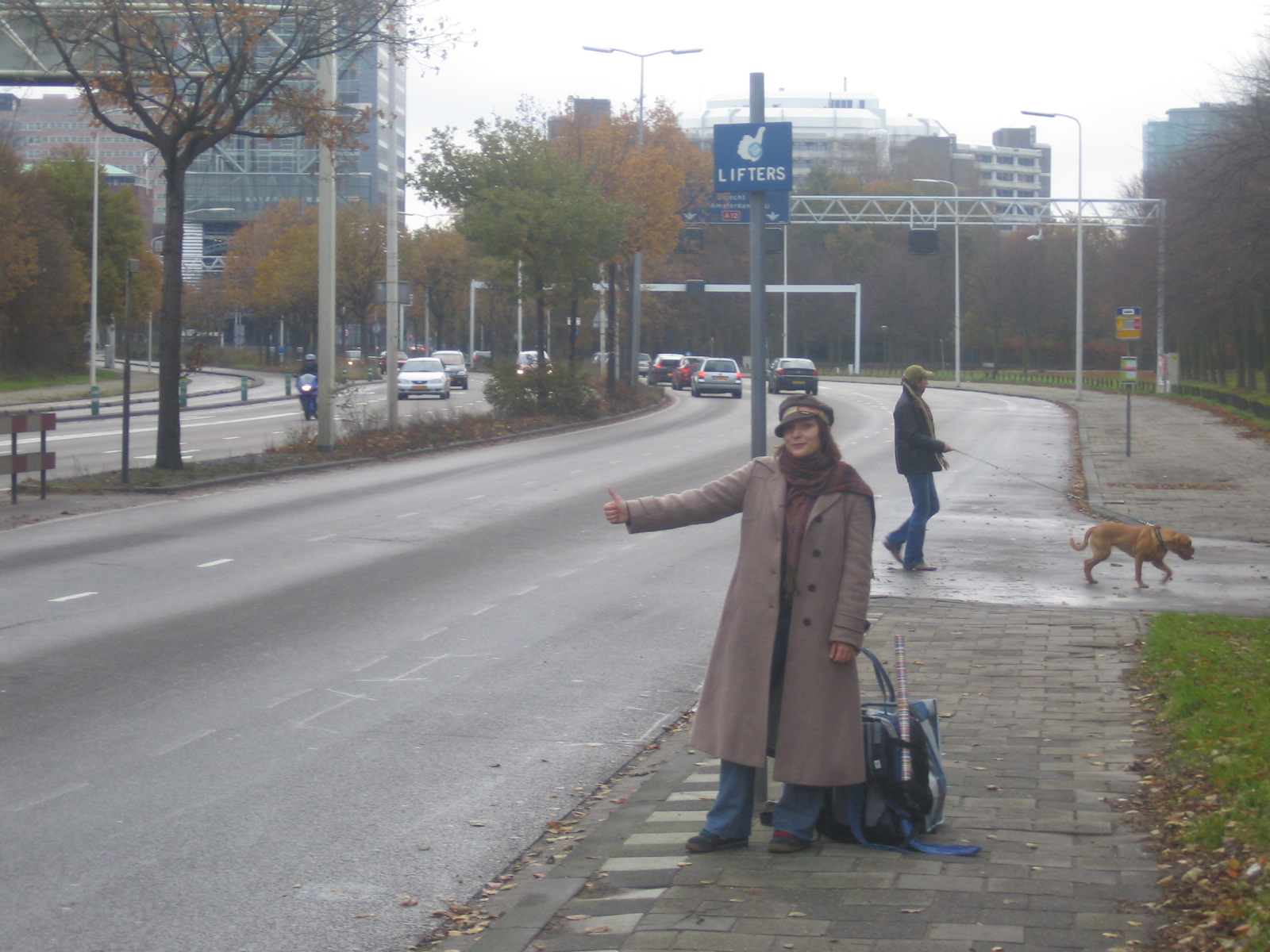
Guaka · Wikimedia Commons · CC BY-SA 3.0

Has hitchhiking died out?
No. People still travel by hitchhiking, and associations still organise hitchhiking races. One concrete example is the GommerliftRace, which advertised its tenth edition in 2026. Holding out a thumb is not a vanished custom.
Its role has changed, though. For some of today’s hitchhikers, the adventure comes first: meeting people, improvising and the challenge of reaching a destination. That differs from the familiar image of the student who mainly wanted a cheap journey home on a Friday.
Arranging a ride in advance through a platform has one thing in common with it: you use a seat in a car already making the journey. But in traditional hitchhiking, the encounter along the way determines the ride. You do not have a driver yet when you set off.
Anyone seeing a hitchhiker today might glance over in surprise. A backpack, a sign, a thumb. The gesture is still instantly recognisable. What has become unusual is letting your journey depend on it.