36 chances, then patience

The roll of film

You could not immediately see whether a photograph had worked. You only knew how many exposures remained. Film made photography more expensive, slower and more suspenseful.

Wind on to picture 1
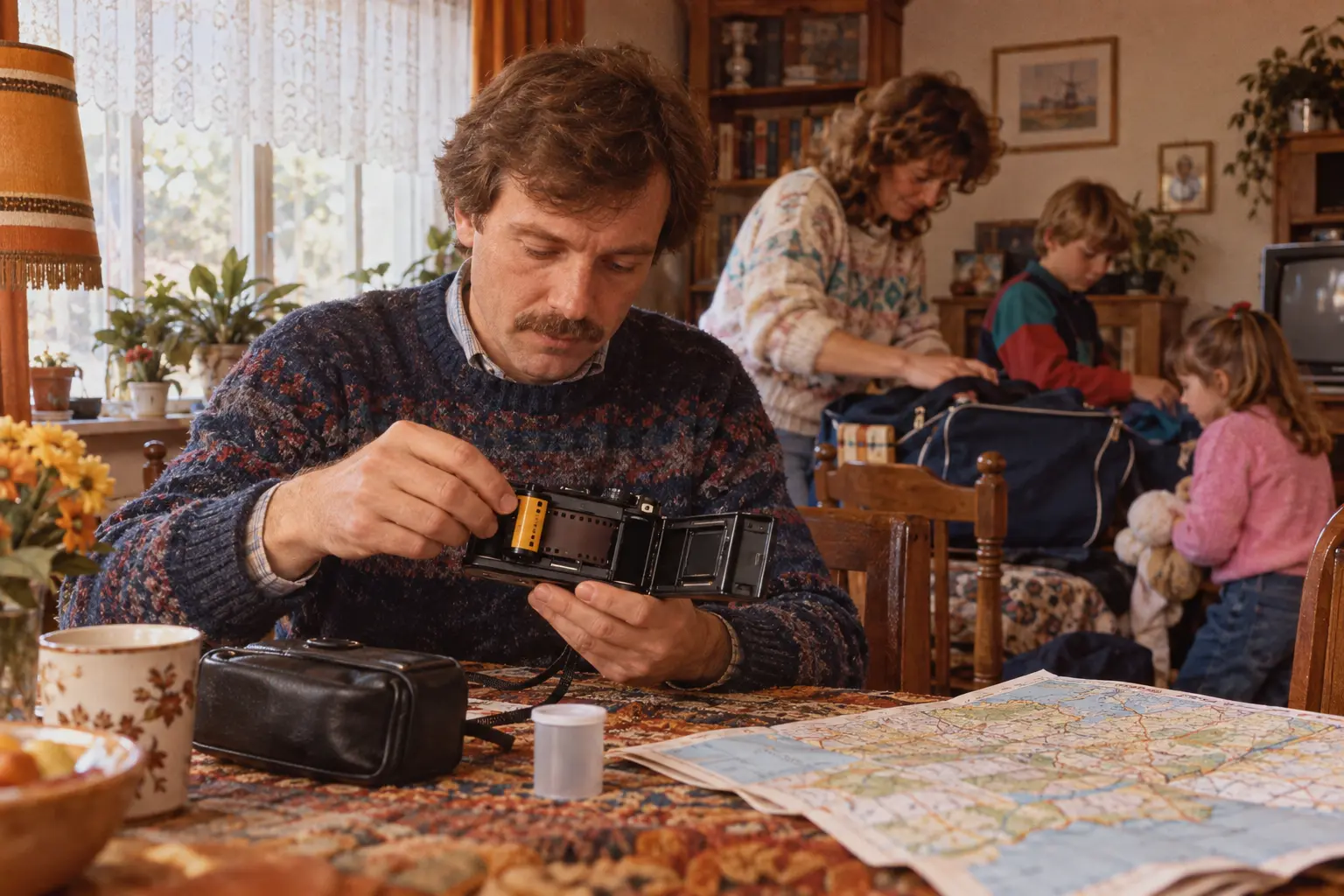
A father loads film into a camera around 1985 while the family packs for a holiday
Before leaving, load the film properly. Historical impression created for Vroeger.online.
24or 36 exposures
100–400ASA or ISO
0pictures to view immediately

After the shutter clicked, you could only hope nobody had blinked and no finger had covered the lens.

01 · choose and click

EXPOSURES36Then rewind

Anyone who had already taken twenty photographs on the first holiday day often heard comments about it.

Every photograph was a small decision

‘Take another, just in case.’ Anyone who used a camera before digital photography knew that sentence. But the second attempt also used up one of your limited exposures.

A little canister full of memories

Most simple cameras held a metal or plastic cartridge of 35mm film. A roll usually offered 24 or 36 exposures. Careful photographers could sometimes squeeze out an extra frame. Picture 37 was not on the packaging, but turned out to exist after development.

The film itself was a long, light-sensitive strip. For each photograph, a fresh section moved behind the lens. Light hit it for a fraction of a second, leaving an invisible image. Only chemical development revealed the pictures.

The Dutch word fotorolletje — literally ‘little roll of film’ — was used for almost all amateur photographic film, although 35mm film actually came in a cartridge. Kodak, Agfa, Fujifilm and own brands from chemists and department stores sat side by side on the shelves.

A whole holiday in 36 pictures

The outward journey, hotel, beach, day trip, children beside a fountain and last evening on the terrace sometimes all had to fit on one roll. Photography therefore meant choosing. Was everyone positioned well? Was there enough light? Was this moment really worth a picture?

Many simple cameras gave little help. Indoors, you needed flash; backlighting turned a face into a dark patch; and the viewfinder did not always show exactly what the lens captured. A head might therefore suddenly be missing from the print.

Do you remember…?

…someone asking after every group photograph whether it had ‘come out’, when nobody could possibly know?

100, 200 or 400?

The box stated a sensitivity: 100, 200 or 400 ASA, for example, later usually called ISO. A low number suited bright daylight. Higher sensitivity was more useful in gloomy weather or indoors, but often produced more grain.

For many occasional photographers, the number remained somewhat mysterious. They bought the film recommended by the camera shop or an own brand on special offer. Serious amateurs deliberately chose a particular film for its colours, contrast and grain.
02 · waiting for the envelope

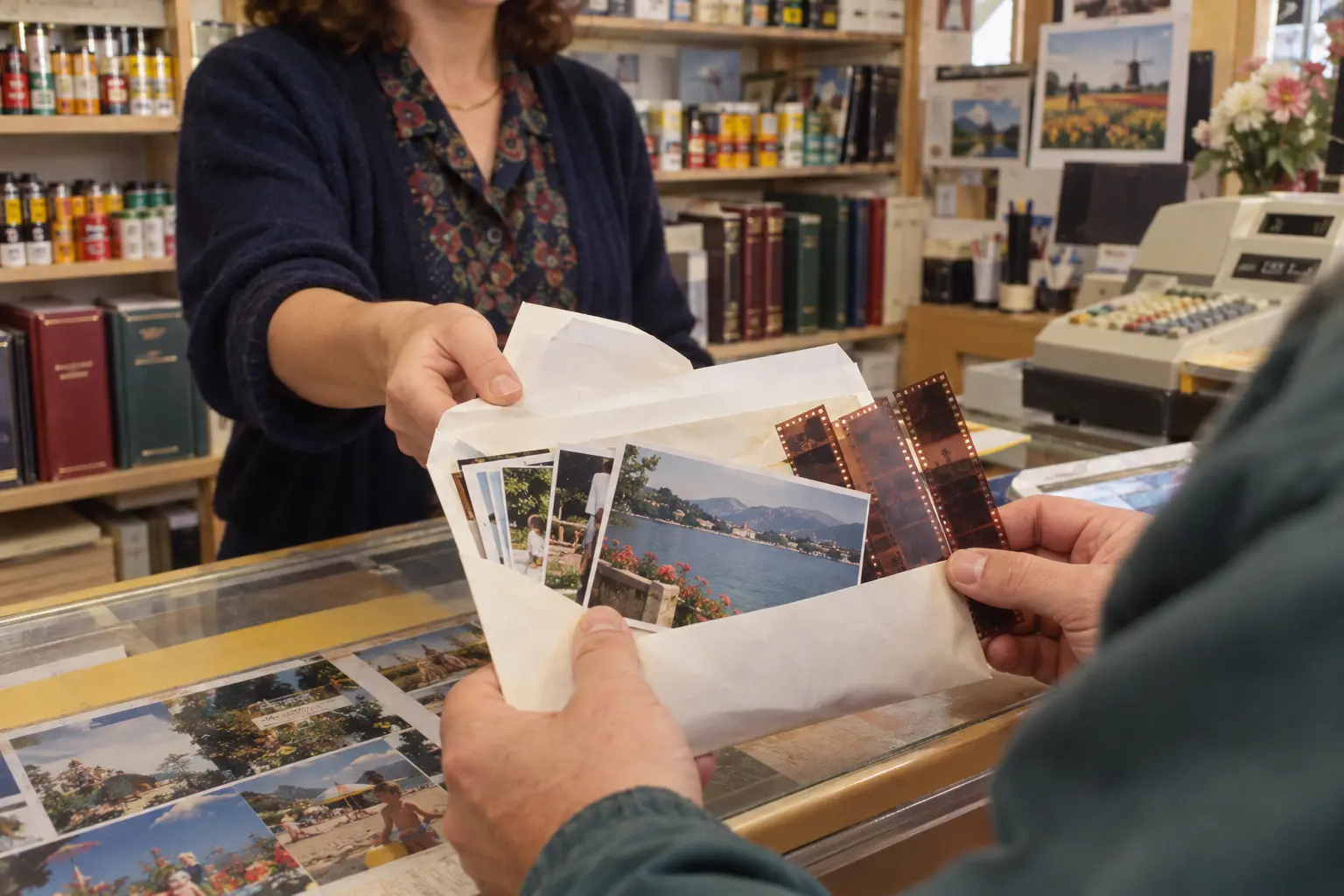
A customer receives an envelope of prints and negative strips in a camera shop around 1992
Opening the photograph envelope was the moment of truth. Historical impression.

Failure or beauty: only when collecting the prints did you discover what the holiday had really captured.

The photographs still had to emerge

After the last exposure, the roll was still far from being a stack of photographs. First, the film had to be safely rewound, handed in and developed.

Do not accidentally open the back

Loading a new roll required attention. The film leader had to be inserted into a spool or hooked behind a catch. You then wound carefully until the film advanced properly. Sometimes someone discovered after 36 supposed pictures that the film had never moved.

Opening the back before rewinding was even riskier. Daylight could damage the pictures in seconds. While rewinding, you listened to the mechanism. When the tension disappeared, the film was safely back inside its cartridge.

From click to print

  1. 1
    Rewind

    The exposed film returned to its light-tight cartridge.

  2. 2
    Hand it in

    The roll went to the camera shop, chemist or department store.

  3. 3
    Developing

    A chemical process made the invisible images visible.

  4. 4
    Printing

    The photographs and negative strips returned in a paper envelope.

Days of waiting — later sometimes an hour

Initially, development could take days or longer. Later, shops promised a service within a day or even an hour. Yet waiting remained part of the experience. The collection slip had to be kept carefully: it was your ticket to your own memories.

The envelope contained glossy prints, usually 9 by 13 or 10 by 15 centimetres. The negatives came back too, cut into strips and protected by sleeves. For an enlargement, you had to find the correct frame number among those tiny, reversed images.

Photographs around the kitchen table

Opening the envelope was often a shared occasion. Prints passed from hand to hand. Blurred pictures and red eyes sank to the bottom of the pile; successful ones went into an album, frame or a parent’s or grandparent’s wallet.

Sometimes there was a picture nobody remembered taking. Because time had passed, developing film felt like a small visit to the recent past.

The real original

Keep the negatives

They were easily forgotten, but negatives allowed new prints and enlargements. Many family archives still lie in envelopes and shoeboxes — sometimes without dates, places or names.

03 · from scarcity to abundance

The digital camera removed the cost and uncertainty of each picture — and changed how we looked.

The digital camera made film unnecessary

A failed digital photograph could be deleted immediately. A memory card held dozens, later hundreds and thousands of images.

As mobile phones acquired better cameras, film lost its familiar place. Camera shops disappeared, processing laboratories closed and manufacturers dropped film types. Albums gave way to computer folders, social media and cloud storage.

Something else arrived too: abundance. Where a holiday once produced 36 carefully chosen pictures, people now easily take more photographs in a day than they once took in a year. They are often technically better, but many are never viewed again.

What else disappeared?

It was not only film that left everyday life. Its small rituals faded too: checking the counter, saving the last exposures, rewinding, keeping the collection slip and opening the photograph envelope with the whole family.

04 · rediscovered

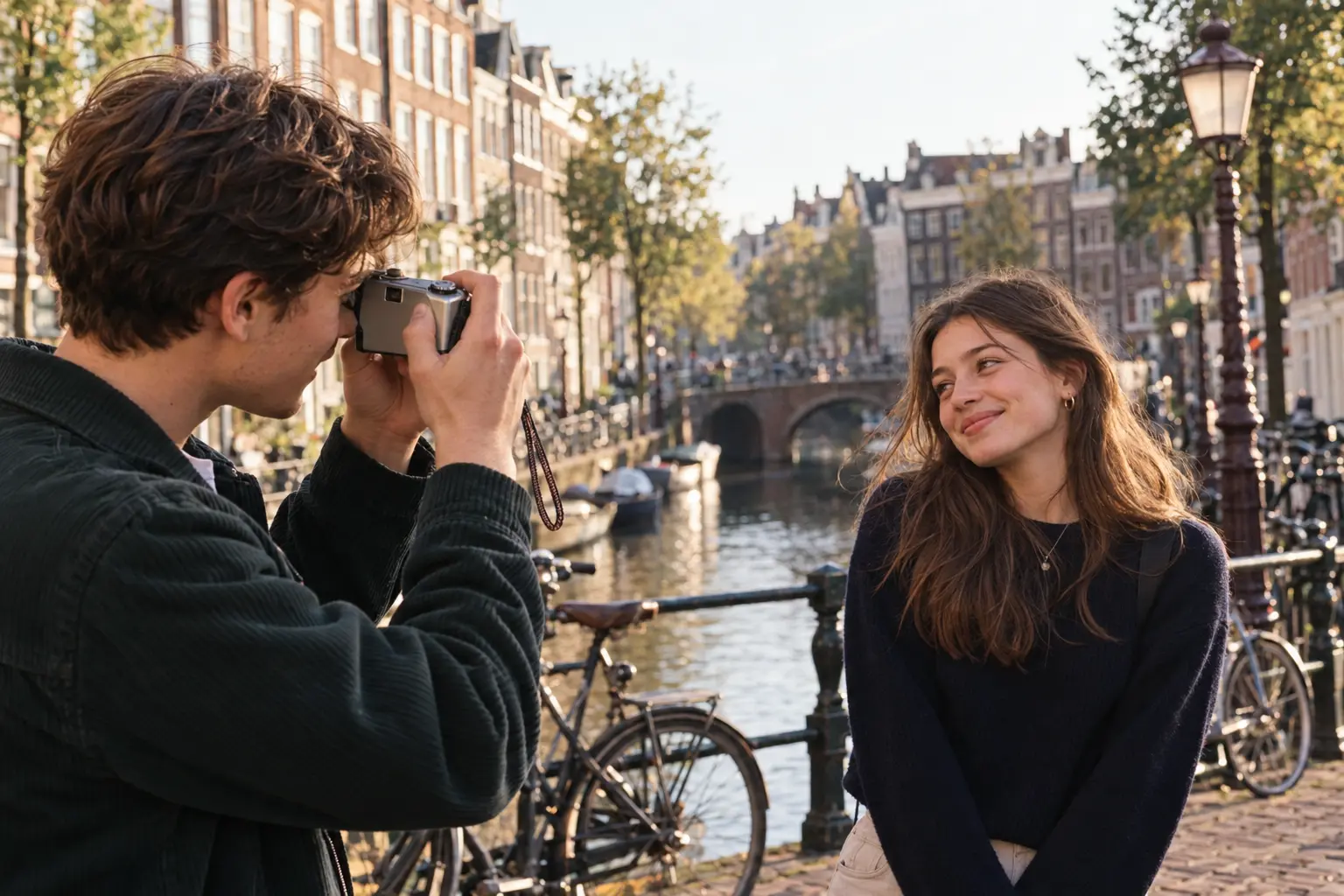
A young man photographs a young woman with an analogue compact camera beside an Amsterdam canal
For a generation raised with smartphones, analogue photography feels new.

No little screen, no immediate check and no automatic ten pictures of the same moment.

Why young people are rediscovering film

Analogue photography is no longer a mass market, but film has made a remarkably persistent return — especially among young people who never experienced its first heyday.

The limits are part of the appeal

Second-hand compact cameras, simple reusable cameras and disposable cameras appear at parties, festivals and holidays. Limited exposures encourage closer observation. Without a screen, everyone does not immediately huddle around the camera after each picture.

Grain, slight softness and unexpected colours are part of the attraction too. Digital filters imitate the look, but the chance effects of real film can never be entirely predicted.

A photograph without likes

You can hold a print, hang it on a wall or give it to someone. It also need not immediately go online to be edited and judged. A moment can simply remain a moment at first. For young people constantly surrounded by screens, that makes analogue photography special.

Manufacturers have noticed the interest. Pentax developed a new film camera partly because of its growing popularity among younger photographers. In 2026, Fujifilm celebrated forty years of QuickSnap with new variants, including a black-and-white model. The market is small compared with the past, but certainly not dead.

Neither cheap nor perfect

Buying film, having it developed and getting scans or prints now costs considerable money. Old cameras are not always reliable either. Yet those costs and uncertainties make each press of the button a choice again.

The charm of not knowing immediately

Perhaps the subject looked wonderful. Perhaps the picture was blurred. Perhaps the film was loaded incorrectly. The answer came later — and sometimes a memory became precious precisely because it was imperfect.

Explore further

Sources & illustrations

More pictures & sound

Sometimes you rewound a tape with a pencil.

Read about the cassette tape